
Skip to content
Get your free gift ENES
Painting of four open doors in a bright room, each opening onto a different sunlit landscape.
Reading guide

Novels about compassion instead of judgment

On the quick verdicts many of us carry, and on stories that let us walk a while in someone else’s shoes.

A man outside a bakery says good morning, and someone hurries past without a word. A young mother at the checkout fumbles with coupons while the line grows longer. A colleague answers too sharply in a meeting. Maybe somewhere inside, before any real thought, a little judge speaks up.

Most people know that voice. It is fast, it is sure of itself, and it rarely has all the facts.

This page is about the space between that quick verdict and something gentler. It looks at why we judge so quickly, where the old image of “walking in someone’s shoes” comes from, what research suggests about fiction and empathy, and a few small ways to see others, and ourselves, a little differently. At the end you will find two novels by Noah Lindholm that turn this question into a story.

No one here is asking for perfection. Only for a pause.

The verdict that comes before the thought

Why do we judge so fast?

Part of the answer is simple economy. The mind sorts the world quickly so that we can act. A face, a posture, a voice, and the brain fills in a story. Most of the time this saves energy. Sometimes it gets people badly wrong.

Social psychologists have a name for one common pattern. In 1977 the psychologist Lee Ross called it the fundamental attribution error: when we explain other people’s behavior, we tend to blame their character, and we overlook their circumstances. A related pattern, studied separately and found to be weaker, concerns how we explain our own behavior: there we tend to point to circumstances. Someone else is late because they are careless. We are late because of traffic.

There is a second layer. Judgments are often handed down. A family that keeps its doors closed, a father who never praised, a mother who could not hold a child: hardness can travel from one generation to the next, often without anyone choosing it.

And a third: sometimes we judge in others what we have not yet made peace with in ourselves. The harshest verdict is sometimes the one we turn inward.

None of this makes anyone a bad person. It makes us human. The question is what happens when we notice.

Where the shoe idea comes from

The image of “walking a mile in someone’s shoes” is so familiar that it seems ancient. Its exact origin is uncertain. It is often linked to the American poet Mary T. Lathrap, whose poem “Judge Softly,” first published in 1895, asks the reader not to criticize a person until they have walked a mile in that person’s moccasins. Similar sayings are sometimes attributed to Native American traditions, but there is no reliable source for a specific origin.

The idea behind it is much older. Many spiritual traditions warn against hasty judgment. In the Sermon on the Mount, Jesus speaks of the speck in a neighbor’s eye and the log in one’s own. Buddhist teaching describes compassion, karuna, as one of the four boundless qualities of the heart.

In recent decades, researchers have studied empathy directly. Two findings are worth knowing.

Empathy and compassion are not the same.

Work by the neuroscientists Tania Singer and Olga Klimecki suggests that feeling another person’s pain (empathy) and caring about it with warmth (compassion) are related but different. Empathy alone can lead to exhaustion. Compassion seems to bring more resilience and a wish to help.

Fiction may train the imagination for other minds.

Several studies have explored whether reading fiction improves the ability to understand what others think and feel. A widely discussed 2013 paper in Science by David Comer Kidd and Emanuele Castano reported short-term effects of literary fiction; later large replication studies did not confirm the short-term effect, while research on long-term reading habits suggests a small link. A fair summary might be: the evidence is not settled, but many readers report that stories have changed how they see people. That is worth something, even if science is still sorting out how much.

Five myths about compassion

Myth 1: Compassion means approving of everything.

Understanding why someone acted a certain way does not mean agreeing with it. Compassion can hold a clear no and still see the person behind the act.

Myth 2: Compassion is weakness.

It often takes more strength to stay open than to close a door. Many of the hardest moments in a life involve choosing to understand rather than to condemn.

Myth 3: Some people do not deserve it.

This may be the hardest myth to put down, and no one has to force it. But many spiritual traditions suggest that compassion is less a reward for the other person and more a choice about one’s own heart. That choice is never owed.

Myth 4: Compassion means forgetting the past.

Forgiveness and reconciliation are not the same as pretending nothing happened. A person can remember clearly and still choose to see more than the wound.

Myth 5: Compassion is only for others.

The inner judge is often harshest with ourselves. Compassion that leaves out the self tends to burn out.

A small glossary

  • Judgment: a quick evaluation of a person or situation, often made before all the facts are known.
  • Empathy: sensing or imagining what another person feels.
  • Compassion: caring about another person’s suffering, with warmth and a wish to ease it.
  • Self-compassion: treating oneself with the same kindness one would offer a friend.
  • Fundamental attribution error: the tendency to explain others’ behavior by their character and to overlook their circumstances.
  • Estrangement: a break in a relationship, often within a family, where contact has stopped or nearly stopped.
  • Karuna: the Sanskrit and Pali word for compassion in Buddhist and Hindu traditions.

Small ways to see differently

These are invitations, not rules. Maybe one of them fits a particular week.

Catch the verdict.

For one day, notice the quick judgments as they arise: the face, the posture, the tone. No need to argue with them. Just notice: there it is.

Add one sentence.

After a judgment, add one sentence that begins with “Maybe.” Maybe she did not sleep last night. Maybe he just got bad news. The sentence does not have to be true. It only opens the frame a little.

A good morning back.

Is there someone on the daily route who always gets looked past? A nod, a word, a glance can change more than it seems. In A Moon in His Shoes, a man who never once nodded back to a stranger outside a bakery learns how much a single greeting can carry.

One closed door.

Is there a door in the family that has stayed shut for years? No one has to open it today. Maybe it is enough to wonder, once, what the person on the other side might have carried.

The role someone played.

This one is only an invitation, and it may not fit everyone. In The Gift, a fable plays with the idea that the difficult people in a life may have had a part in it. It is a story, not a fact, and it is not meant for harm done through abuse or violence. No one owes understanding to a person who hurt them. Compassion never requires reconciliation or renewed contact. If the idea feels wrong, it can simply be skipped.

Turn it inward.

At the end of the day, one question: Where was I hard on myself today? And one small kind sentence in reply.

Common questions

Questions and answers

What does it mean to walk in someone else’s shoes?

It means imagining another person’s life from the inside, with their history, pressures, and fears, before judging what they do. The phrase is often linked to Mary T. Lathrap’s 1895 poem “Judge Softly.”

What is the difference between empathy and compassion?

Empathy means feeling or imagining what another person feels. Compassion adds care and a wish to help. Research suggests that compassion may be more sustainable than empathy alone.

Can reading novels make us more empathetic?

Some studies suggest that reading fiction can improve the ability to understand others, though later research has found mixed results. Many readers say that stories have changed how they see people, even if science has not settled how much.

Is there a novel about someone who judges everyone?

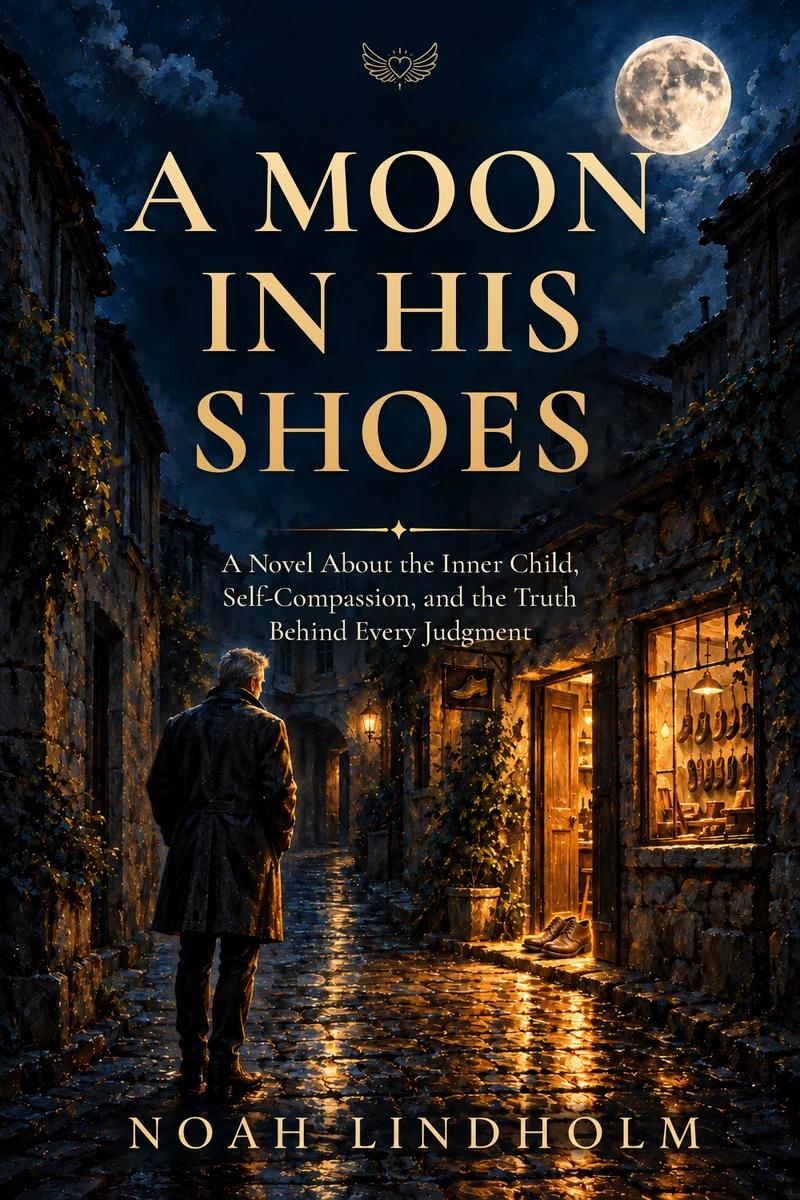
Yes. In A Moon in His Shoes by Noah Lindholm, an architect who has a verdict for everyone is offered a strange deal by an old shoemaker: to wear strangers’ shoes and live their lives for one moon each, while his mother lies dying in a hospice.

Is there a novel about seeing difficult people in a new light?

The Gift by Noah Lindholm is a modern fable about a tired man on a subway who is reminded, by a stranger, that his life and the people in it may have a meaning he has forgotten. It offers this as a perspective, not as a claim of fact.

Are these books religious?

They are spiritual in tone but open to readers of any faith or none. They tell stories and leave the big questions to the reader.

Do these novels deal with difficult topics?

Yes, with care. A Moon in His Shoes touches on dying, the loss of a child, homelessness, poverty, and addiction. The Gift touches on loss, loneliness, a difficult childhood, illness, death, the death of a child, and thoughts of not wanting to live.

Which book should I read first?

If you want a moving story about a mother and son and the lives of strangers, start with A Moon in His Shoes. If you want a shorter, more cosmic fable with a wink, start with The Gift.

Two stories

Two novels that let you walk a while in someone else’s shoes

novel

A Moon in His Shoes

Jakob Reuter is an architect, soon to turn fifty. His houses are straight and honest. People he understands less well. Every day a man outside the bakery at the station wishes him good morning, and Jakob has never once nodded back. Then the hospice calls: his mother, who never held him on a single evening he can remember, is dying and has asked for him. That night, in an alley that is on no map, an old shoemaker offers him a pair of worn boots and a life to live for one moon. One stranger’s life follows another, while time runs out at his mother’s bedside.

Content note: dying, the loss of a child, homelessness, poverty, and addiction, told with quiet care.

Join the Reader PanelAbout the book
novel

The Gift

Noam is forty, tired, and armored in cynicism. One gray Tuesday the subway does not stop at his station. It stops at a platform of white marble that opens into the night sky, where a stranger named Calum is waiting, a man who looks like an old stationmaster and seems to know exactly why Noam is there. What follows is a journey through the Workshop of Souls, toward the question of whether the hard parts of a life, and the people who caused them, might be more than an accident. A warm modern fable, told with a wink, that offers this view as a possibility, not a teaching.

Content note: loss, loneliness, a difficult childhood, illness, death, the death of a child, and thoughts of not wanting to live. In the US, you can call or text 988 at any time.

Join the Reader PanelAbout the book

The English editions were translated from the German originals with the help of AI. Not yet published in English.

A gift for the road

The Reading Journal, free by email

A printable booklet for the sentences that stay after a book. Maybe also a page for one person you would like to understand a little better.

Free. About one short letter a week from Noah Lindholm. Unsubscribe anytime with one click. Privacy

More to read

Sources

  1. Lee Ross, “The Intuitive Psychologist and His Shortcomings,” Advances in Experimental Social Psychology 10 (1977).
  2. Mary T. Lathrap, “Judge Softly” (1895). The origin of the phrase is disputed (see Quote Investigator).
  3. Matthew 7:3-5 (the speck and the log), paraphrased.
  4. Tania Singer and Olga M. Klimecki, “Empathy and compassion,” Current Biology 24 (2014), pp. R875-R878.
  5. David Comer Kidd and Emanuele Castano, “Reading Literary Fiction Improves Theory of Mind,” Science 342 (2013); replication attempts with mixed results, e.g. Panero et al., Journal of Personality and Social Psychology (2016).
Text