On the habit of waiting for life to start, and on stories that gently interrupt it.
Once the kids are older. Once the loan is paid off. Once work calms down. Once I lose the weight, find the right partner, finish the degree, retire.
Many people carry a sentence like this somewhere inside. It sounds reasonable, even responsible. And it quietly moves real life to a date in the future that keeps sliding further away.
Maybe that sounds familiar. Maybe not at all.
This page is about the question underneath: What would it mean to live now, in the life that already exists, instead of waiting for a better one? It looks at the habit of putting life off, at what philosophers and psychologists have said about meaning, at a few myths, and at small ways to practice presence. At the end there are three novels by Noah Lindholm that tell this question as a story.
The “once I…” game
The pattern has many names. The psychologist Tal Ben-Shahar calls it the arrival fallacy: the belief that happiness waits at the next milestone. In The Man Who Waited for His Life, it is called the if-then game. If I become enough, then life can begin.
It is a clever game, because it rarely feels like waiting. It feels like working, planning, improving. And each goal reached makes room for the next. The finish line moves with the runner.
Psychologists who study procrastination, among them Fuschia Sirois and Timothy Pychyl, describe it less as laziness and more as a way of managing uncomfortable feelings in the moment. In a widely cited 2007 review of the research, Piers Steel described procrastination as a voluntary delay despite expecting to be worse off for it. People often delay what feels uncomfortable now, even when they care about it.
That is true for big things too. A call to an old friend. A conversation that is overdue. A trip, a change of work, a sentence like “I love you” or “I’m sorry.” Small postponements, repeated for years, can add up to a life.
None of this is a reason for guilt. Many people play the game. The interesting question is what happens when someone notices it.
What thinkers have said about meaning
The question of how to live a meaningful life, and how not to waste it, is very old.
Seneca (around 4 BCE to 65 CE). The Roman philosopher wrote a short essay called On the Shortness of Life. His point was that life is not short in itself. It becomes short because so much of it is spent waiting, rushing, and living for later. In the first of his Letters to Lucilius, he put it in four Latin words, dum differtur vita transcurrit:
“While we are postponing, life speeds by.”
Seneca, Letters to Lucilius, Letter 1, translated by Richard M. Gummere
The mystics. Medieval teachers like Meister Eckhart spoke of the “eternal now,” the idea that the divine is met only in the present moment, never in the past or the future.
Viktor Frankl (1905 to 1997). The Austrian psychiatrist survived several Nazi concentration camps. In Man’s Search for Meaning (first published in German in 1946), he argued that meaning can be found even in the hardest circumstances, through love, through work, and through the attitude a person takes toward suffering that cannot be avoided. He did not claim that suffering is good or necessary. His approach became known as logotherapy.
Regrets of the dying. The Australian palliative care worker Bronnie Ware wrote about the regrets she heard most often from people near the end of life. In her book The Top Five Regrets of the Dying (2011), which draws on her own experience rather than on a study, she wrote that the regret she heard most often was not having had the courage to live a life true to oneself rather than the life others expected.
Modern research. Psychologists today often separate happiness from meaning. Some studies link a meaningful life to connection, contribution, and a sense of coherence, and they find that such a life can include difficulty. Meaning, in this view, is not the absence of hardship but a way of relating to life as it is.
What these voices share is a simple and demanding idea: the life to be lived is this one, now.
Five myths about a meaningful life
Myth 1: Meaning comes when the big goal is reached.
Goals can give direction, but many people find that reaching one does not bring the meaning they hoped for. Meaning often hides in ordinary moments along the way.
Myth 2: Living now means giving up on the future.
Presence and planning are not opposites. It is possible to save for retirement and still taste the coffee this morning.
Myth 3: You have to find your one big purpose.
For some people a single calling is real. For many others, meaning comes from many small things: people, work done well, beauty, kindness.
Myth 4: Everything happens for a reason.
This sentence is often meant as comfort, but it can feel like a denial of real pain. A gentler version might be: maybe something good can grow out of this, even if it was not meant to happen.
Myth 5: Positive thinking fixes it.
Constant positivity can become another form of avoidance. Honest attention to what hurts can be part of a meaningful life, too.
A small glossary
Presence: full attention to what is happening right now, in the body, the senses, and the people around.
Arrival fallacy: the belief that reaching a goal will bring lasting happiness.
Procrastination: putting off something one intends to do, even while expecting that delay to cost something.
Gratitude: noticing what is already there and of value.
Logotherapy: Viktor Frankl’s approach, centered on the search for meaning.
Toward and away from: the difference between moving toward something one wants and running away from something one fears. The direction can change how the same step feels.
The eternal now: a mystical idea that the present moment is the only place where life, and the divine, can truly be met.
Living now, in small steps
These are not rules or a program. They are small experiments. Maybe one of them is worth trying this week.
Notice the “once.”
For one day, listen for sentences that begin with “once I” or “as soon as.” No need to change them. Just notice how often they appear.
Do one postponed thing.
Pick something small that has waited too long: a short message, a walk, a page of the book on the nightstand. Do it today, imperfectly.
Toward instead of away.
Before a decision, one question: Am I moving toward something, or only away from something? In The Man Who Waited for His Life, this question quietly changes a whole life.
Three good things.
In the evening, three things from the day that were good, however small. Research on gratitude exercises suggests they can lift mood for some people, and they cost two minutes.
A morning feeling.
Before getting out of bed, one breath to call up a pleasant feeling: warmth, calm, anticipation. In the evening, return to it. Small, but it can shift the color of a day.
The three-second pause.
In One Day Is Today, a young man turns a coin before answering a text. Maybe the next small reply deserves three seconds of attention too.
If an exercise feels forced, it can be dropped. Living now is not another task to do perfectly.
Common questions
Questions and answers
What are good books about finding meaning in life?
Classics include Man’s Search for Meaning by Viktor Frankl and Seneca’s On the Shortness of Life. Many readers also turn to novels, which let them feel the question through a character. The Man Who Waited for His Life, One Day Is Today, and The Gift by Noah Lindholm are three spiritual novels on this theme.
Is there a novel about someone who keeps waiting for life to start?
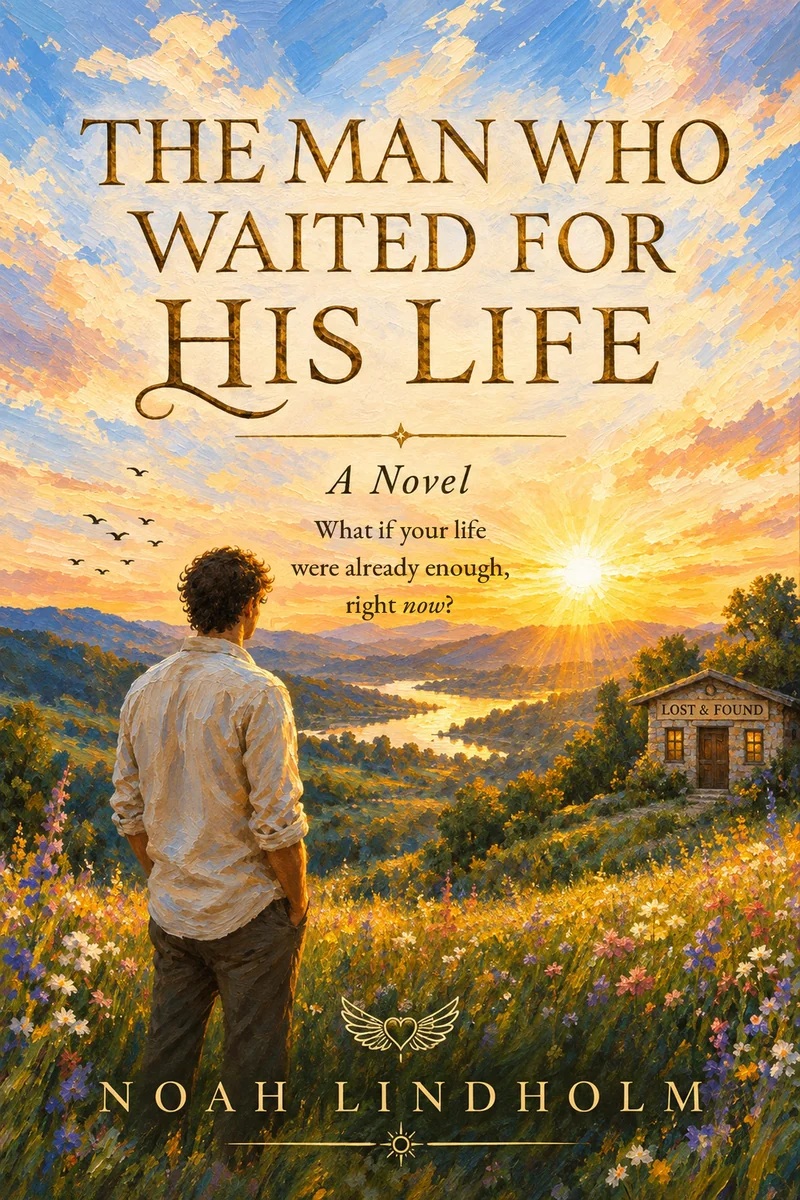
Yes. The Man Who Waited for His Life by Noah Lindholm follows Paul Winter, who believes real life will begin once he is finally enough, until a mysterious lost and found office changes how he sees what he already has.
Is there a novel about procrastination?
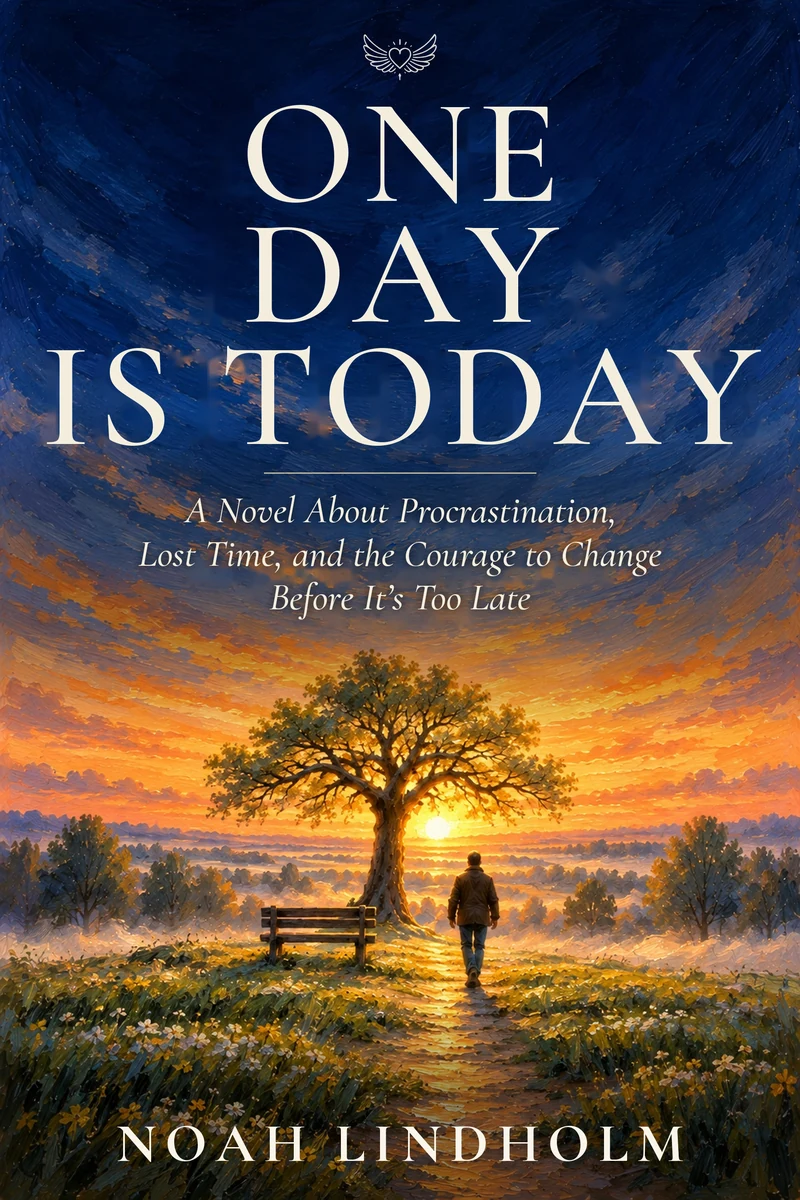
One Day Is Today by Noah Lindholm is built around one small postponement. On a rainy evening, a young man answers a text, and the story splits into five possible lives, one for each answer.
What does it mean to live in the present?
Living in the present means giving full attention to what is happening now, instead of being lost in the past or the future. It does not mean giving up plans, only not postponing life itself.
Are these books self-help?
No. They are novels. They contain no step-by-step program, and the meaning grows out of the story. The Man Who Waited for His Life includes a short appendix with small experiments for readers who want them.
Are these novels religious?
They are spiritual in tone but open to readers of any faith or none. They ask questions rather than teach doctrine.
Which book should I read first?
If you are drawn to quiet magic and a mentor figure, start with The Man Who Waited for His Life. If you like stories told in several versions, and a lot of warmth and humor, start with One Day Is Today. If a modern fable about what an ordinary life is for sounds right, start with The Gift.
Paul Winter is waiting. For the right moment, for enough success, for the version of himself that finally deserves to live. Then he meets Konrad Riedel, the strange keeper of a lost and found office for things people have lost along the way, and an empty jar labeled “Everything you are missing.” A spiritual novel with a touch of magical realism and humor scattered throughout, about the old dream of turning lead into gold, and the possibility that the gold was never somewhere else. It closes with an appendix of nine small experiments for daily life.
Jonas is nineteen, standing in the hallway of his first apartment, when his oldest friend texts: “You still coming?” In his pocket is a worn coin from his grandfather, with a note: “Turn it before you answer.” Then the story splits into five lives, one for each possible reply. A law firm, a bar behind the market, an injured ankle, a balcony with a young woman named Mara. A warm, often funny novel about postponing, small habits, and what “next time for sure” may cost.
Content note: the story touches calmly on loss, drinking, and serious illness.
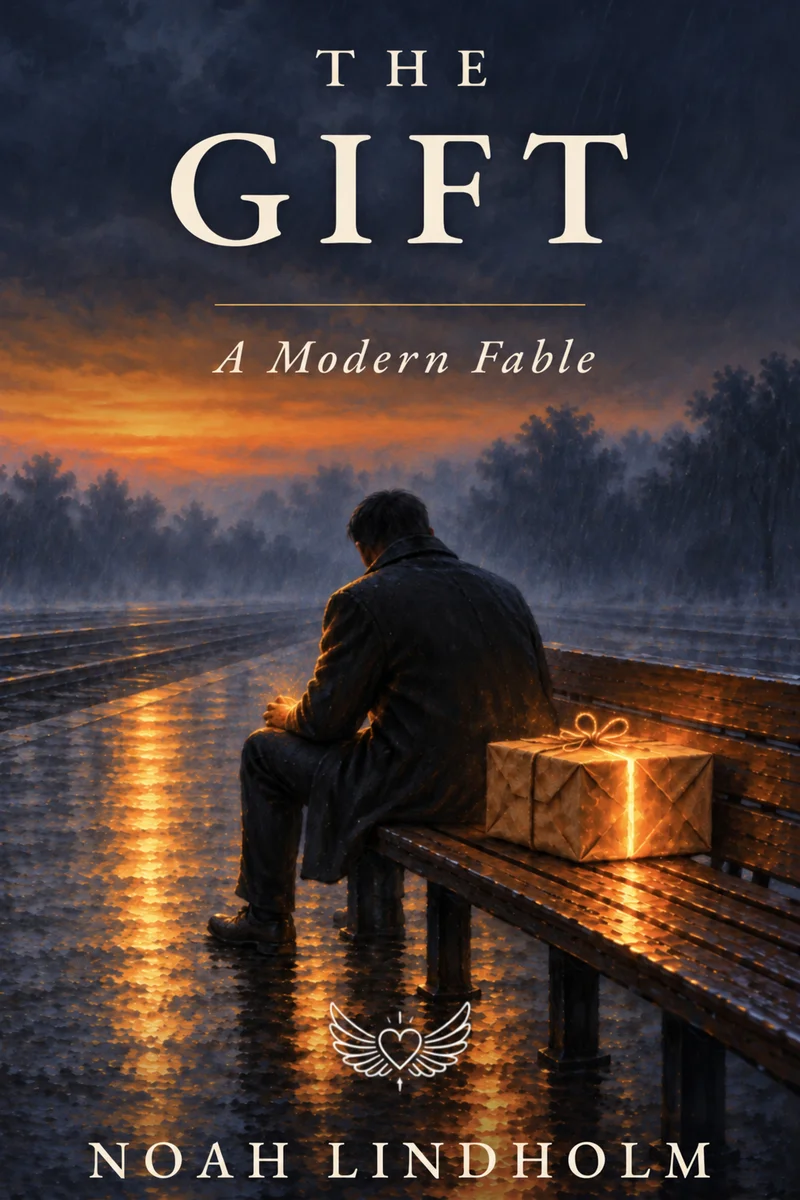
Noam is forty, tired, and armored in cynicism. One gray Tuesday the subway does not stop at his station. It stops at a platform of white marble that opens into the night sky, where a stranger named Calum is waiting. What follows is a journey toward the quiet question of what an ordinary human life is really for: coffee, rain on the face, an apple after hunger, felt as if for the first time. A warm modern fable, told with a wink, that offers its view as a possibility, not a teaching.
Content note: loss, loneliness, a difficult childhood, illness, death, the death of a child, and thoughts of not wanting to live. In the US, you can call or text 988 at any time.
Seneca, On the Shortness of Life; Letters to Lucilius 1.2 (“dum differtur vita transcurrit”), quoted in the translation by Richard M. Gummere (Loeb Classical Library, 1917).
Viktor E. Frankl, Man’s Search for Meaning (first published in German, 1946).
Bronnie Ware, The Top Five Regrets of the Dying, Balboa Press, 2011.
Piers Steel, “The Nature of Procrastination,” Psychological Bulletin 133 (2007), pp. 65-94.
Fuschia M. Sirois and Timothy A. Pychyl, “Procrastination and the Priority of Short-Term Mood Regulation,” Social and Personality Psychology Compass 7 (2013), pp. 115-127.
Meister Eckhart and the “eternal now”: see Encyclopaedia Britannica.
Text
Accessibility
Nothing here is on by default. Whatever you turn on stays that way on your next visit.
Larger textEverything grows with it, images too
More contrastDarker text, boxes behind text on images