Stories cannot take the pain away. Sometimes they can sit beside it for a while.
There is a particular silence after a loss. The phone that does not ring at the usual time. The mug that nobody uses. The sentence that starts with “I should tell her” and stops halfway.
If you are here because of a loss, this page will not try to fix anything. Grief is not a problem with a solution. It can hold love, anger, regret, relief, and feelings that are hard to name.
What a book can sometimes do is keep a person company. It can say: someone else has walked here too. It can let a reader cry over a character instead of over everything at once. And sometimes, gently, a story can open a window to the question that grief so often raises: What comes after? For them, and for us?
This page gathers a few thoughts about grief, some history, a handful of myths worth setting down, small ways people carry it, and two novels by Noah Lindholm that sit at the border between this life and whatever lies beyond.
Take what helps. Leave the rest.
Why read about grief at all?
It might seem strange to pick up a novel about death while grieving. Many people do it anyway, and they often describe the same reasons.
A story can give grief a shape.
Loss can feel formless, a fog without edges. A story has a beginning, a middle, and an end. Following someone else’s path can make one’s own feelings a little easier to name.
A character can carry what is too heavy to look at directly.
It is sometimes easier to watch a fictional mother and daughter fail to say what they meant than to think about one’s own last conversation. And then, slowly, the two begin to touch.
Fiction can hold more than one feeling at once.
Real grief is rarely only sad. It can be angry, relieved, guilty, numb, and suddenly funny, all in the same afternoon. Good novels allow that mix, and that can feel like permission.
A story can ask “what comes after” without forcing an answer.
No book knows what happens when we die. But a novel can imagine it with care and leave the question open, so that a reader can bring their own beliefs or doubts.
How people have thought about grief
Writing about loss is as old as writing itself. The Epic of Gilgamesh, one of the oldest surviving stories, follows a king who cannot accept the death of his friend Enkidu and sets out to find a way past death.
In the twentieth century, a few ideas shaped how many people in the United States talk about grief today.
The five stages.
In 1969 the psychiatrist Elisabeth Kübler-Ross published On Death and Dying, based on her work with dying patients. She described denial, anger, bargaining, depression, and acceptance. The model became famous and was later applied to the grief of those left behind. Kübler-Ross herself and later researchers stressed that these are not steps in a fixed order. Many people move back and forth, skip some, or feel several at once.
Continuing bonds.
In 1996 the researchers Dennis Klass, Phyllis Silverman, and Steven Nickman published Continuing Bonds: New Understandings of Grief. Their work questioned the older idea that healthy grieving means “letting go.” They found that many people keep a relationship with the person they lost, through memories, conversations, rituals, or a sense of presence, and that this can be healthy.
Moving between loss and life.
In 1999 Margaret Stroebe and Henk Schut described the dual process model. It suggests that people cope by moving back and forth: sometimes facing the loss directly, sometimes turning toward everyday life and new tasks. Both directions are part of grieving.
Writers have added their own voices. In A Grief Observed (1961), written after the death of his wife, C. S. Lewis opened with a line many mourners recognize:
“No one ever told me that grief felt so like fear.”
C. S. Lewis, A Grief Observed
Five myths about grief
Myth 1: Grief has a schedule.
There is no correct timeline. Some losses soften within months, others stay close for years. A wave can return on a birthday a decade later. That does not mean something is wrong.
Myth 2: Being strong means not crying.
Tears are not weakness. For many people they are the body’s way of letting something move. And for others tears do not come at all, which is also not a sign of loving less.
Myth 3: You have to let go.
As the research on continuing bonds suggests, many people keep a relationship with the person they lost. Talking to them, keeping a ritual, or wearing a piece of their clothing can be part of grief, not a failure to move on.
Myth 4: Grief is only about death.
People grieve divorces, estrangements, lost health, lost homes, and the life they thought they would have. A daughter who stopped calling can be grieved while she is still alive.
Myth 5: Words of comfort always help.
“Everything happens for a reason” is meant kindly, but it often hurts. Sometimes the most comforting thing is simply someone who stays, listens, and does not try to explain.
A few words that may help
Grief: the inner response to a loss, including feelings, thoughts, and changes in the body.
Mourning: the outer expression of grief: rituals, customs, the ways we show and share it.
Bereavement: the situation of having lost someone through death.
Anticipatory grief: grief that begins before a loss, for example during a long illness.
Disenfranchised grief: a term from the researcher Kenneth Doka for grief that others do not recognize, such as for an ex-partner, a pet, or a pregnancy loss.
Continuing bonds: an ongoing inner relationship with the person who died.
Unfinished business: things that were never said or settled, which often weigh heavily in grief.
Small ways to carry it
None of these is a cure, and none is required. They are things that some people have found helpful. Maybe one of them fits a particular day.
Write the letter.
A letter to the person who is gone, with everything that was never said. It does not have to be sent or shown to anyone. In The House of Answers, a mother carries a message to her daughter that she types, deletes, and types again. Some messages need to be written before they can rest.
Keep one ritual.
A candle on a certain day, a favorite meal cooked once a year, a walk along a route you used to take together. Rituals can give grief a place to go.
Name the good and the hard.
Relationships are rarely only one thing. It can help to remember both what was beautiful and what hurt, without forcing either to disappear.
Let the body help.
A walk, a warm bath, sleep when it comes. Grief lives in the body, too, and gentleness toward the body is a form of gentleness toward the grief.
Find one person.
Not a crowd. One person who can listen without fixing. A friend, a relative, a support group, a counselor.
Read slowly.
A story read in small pieces, maybe a chapter a night. If a scene is too close, it is fine to close the book and come back another day.
Common questions
Questions and answers
Can reading a novel help with grief?
A novel cannot replace support from people or professionals, but many readers find that a story keeps them company. Seeing a character move through loss can make one’s own feelings easier to name.
What are some novels about grief and the afterlife?
Readers often mention The Five People You Meet in Heaven by Mitch Albom and The Lovely Bones by Alice Sebold. Noah Lindholm’s The House at the Edge of Eternity and The House of Answers also explore the border between this life and what may come after.
Are novels about the afterlife religious?
Not necessarily. Many afterlife novels are open to readers of any faith or none. They imagine what might come after without claiming to know.
Is it normal for grief to last a long time?
Yes. There is no fixed timeline for grief, and feelings can return around anniversaries or other moments. If grief makes daily life very hard for a long time, talking to a doctor or grief counselor can help.
What should I read when I am grieving a parent?
Some people prefer memoirs, others prefer fiction, which can feel less direct. The House of Answers follows a mother and daughter who were estranged, and may speak to anyone with words still unsaid within their family.
Are these books suitable right after a loss?
That depends on the person and the day. Both novels on this page deal with death openly and with care. It may help to read the free sample first and see how it feels.
Do these books promise that everything will be all right?
No. They tell stories, and they leave the big questions open. They are not a substitute for counseling, therapy, or medical care.
Who is Noah Lindholm?
Noah Lindholm writes spiritual novels and modern fables about who we are and how we might come home to ourselves.
Two stories
Two houses at the edge of this life
These novels do not explain grief. They walk through it slowly, with a little light at the windows.
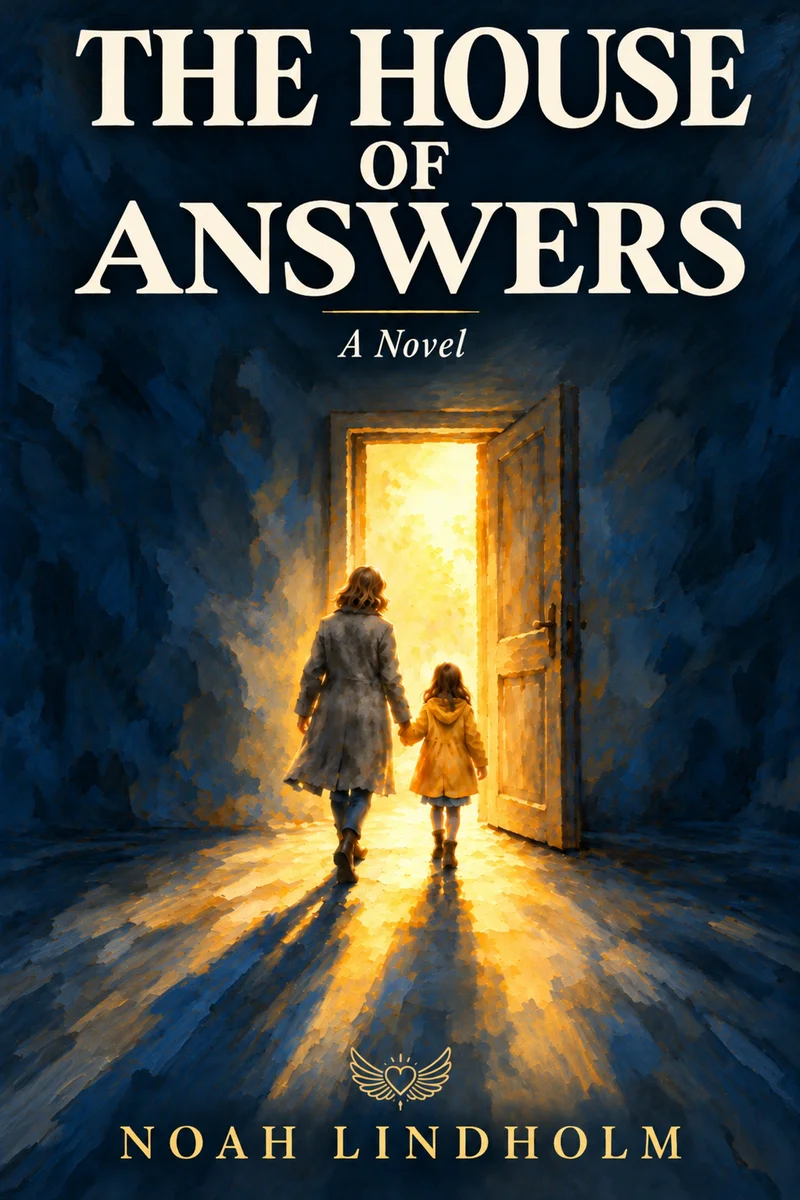
Sabine has spent fifty-one years apologizing. On her daughter Anna’s birthday, after three years of distance, she waits outside Anna’s building with a tin of cinnamon rolls and a message she cannot send. Then her chest grows heavy, and she wakes in the house where she grew up. A clock there runs backward, and behind each door waits someone who is still owed an answer. A warm, honest story about mothers and daughters, unspoken words, and grief and humor held in the same hand.
Content note: a sudden death, a child in the hospital, and a brief mention of a miscarriage, all treated with care.
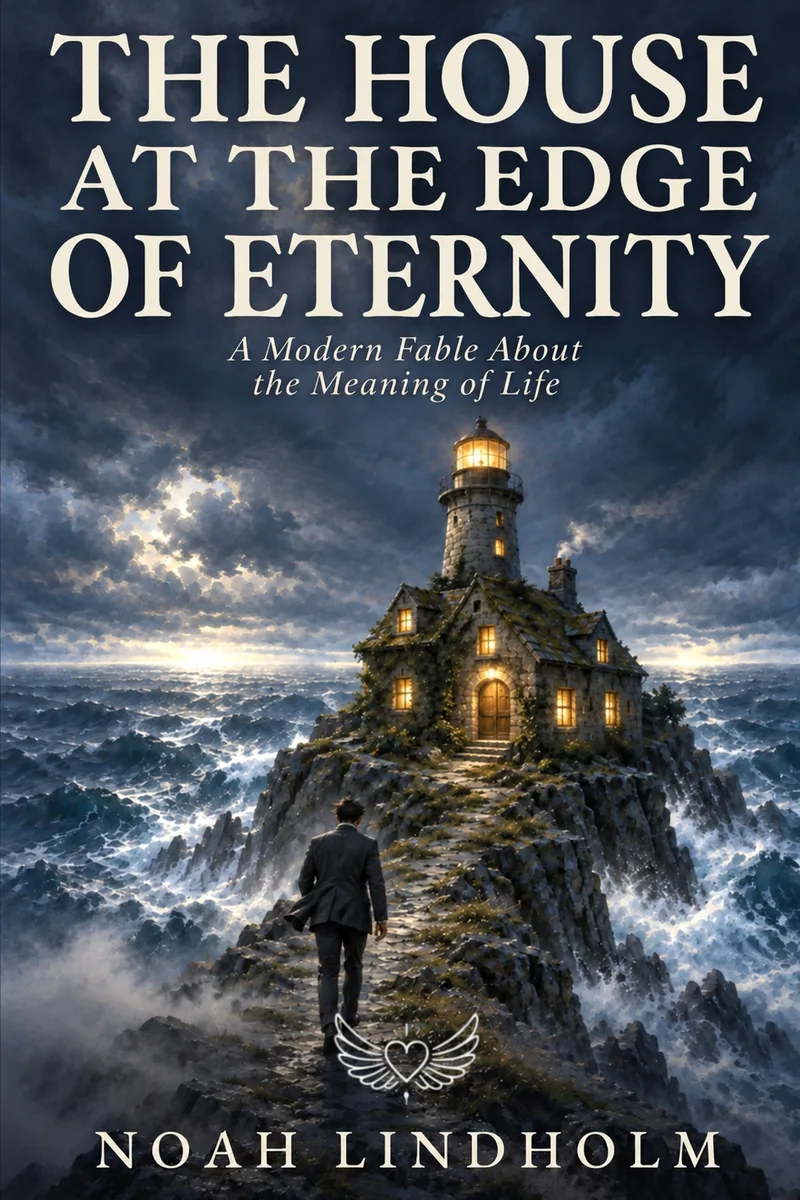
On a November evening, Levin Salinger’s car leaves the road. He wakes in thick fog at the edge of a vast ocean, near a crooked old country house with a lighthouse rising from its roof. Inside, a woman at the stove already knows his name, and a host who never looks quite the same leads him room by room through the beliefs his life rested on. Where is he? And why does the house seem to have been expecting him? A short modern fable for anyone who has wondered whether there is more beyond the ordinary week, and beyond this life.
Content note: a car accident and a hospital scene (not graphic).
The English editions were translated from the German originals with the help of AI. Not yet published in English.
If it feels too heavy
If grief feels too heavy to carry alone, please reach out to a doctor, a grief counselor, or a local hospice bereavement program, and if you are in crisis in the United States, you can call or text 988 at any time.
A gift for the road
The Reading Journal, free by email
A printable booklet with space for the sentences that stay. Maybe also a place for a letter that does not need to be sent.